
Client
Northern Ireland Department of Agriculture

Industry
Airborne Mapping

Area
Coastal Zone


Airborne lidar bathymetry closes the data gap

The shallow nearshore coastal zone plays a critical role in coastal erosion processes, flood risk and ecosystem dynamics, yet it is one of the most difficult environments to survey. This article examines how airborne lidar bathymetry has been successfully used to survey the full coastal zone of Northern Ireland, representing the first bathymetric lidar project of this scale undertaken in the United Kingdom.


Project context

A Northern Ireland coastal erosion risk management studyconcluded that there was a lack of consistent nearshore data, required to reliably identify and map areas vulnerable to erosion and flooding. This lack of data was most pronounced in highly dynamic shallow coastal waters, which play a key role in erosion processes but remain difficult to survey.

In these shallow areas vessel-based multibeam sonar surveys are often constrained by water depth, navigational safety and operational efficiency. As a result, coverage of the land–sea interface is frequently incomplete, leaving an unmapped transition zone between land and water, commonly referred to as the “white ribbon” in coastal surveying.

Airborne lidar bathymetry (ALB) is a proven and efficient technology to address this challenge and close the gap, by using laser pulses to measure terrain elevations both above and below the water surface in a single survey operation.

Against this background, the Northern Ireland Department of Agriculture, Environment and Rural Affairs (DAERA) commissioned a project to map the full coastal zone of Northern Ireland using ALB, to a target water depth of ten meters, covering approximately 700 km² of coastal waters. This survey project represents the first ALB mapping project of this scale undertaken in the United Kingdom and the Norwegian company Field was selected to execute the survey following a tender procedure.


Survey setup and planning

Field executed the survey by using a fixed-wing aircraft equipped with a CZMIL SuperNova bathymetric lidar system developed by Teledyne Optech. This sensor was selected for its high laser power, supporting significant depth penetration, combined with advanced waveform processing that helps maintain reliable bottom detection in turbid and optically complex waters. In the context of Northern Ireland’s environmental conditions, this configuration offered the greatest likelihood of achieving useful bathymetric coverage across a substantial proportion of the 0–10 metre depth range.

In addition, a Phase One iXM-RS150F aerial camera was used to acquire 3cm resolution RGB-imagery simultaneously with the lidar data. The imagery provides valuable contextual information on water clarity, seabed features and coastal morphology, and supports quality control, interpretation and integration of the bathymetric results.

In general, ALB surveys can be executed most efficiently in environments with clear waters and relatively calm wind and wave conditions. In contrast, the coastal waters of Northern Ireland are characterized by quite variable weather conditions, including frequent rainfall and periods of stronger winds, which limit the number of suitable ALB survey windows.

Particularly turbidity, commonly expressed as water clarity, is a critical factor for ALB surveys, as suspended sediments in the water column directly reduce laser penetration and achievable depth. Many nearshore areas in Northern Ireland, specifically the river deltas, have persistently high concentrations of suspended sediments, so it was clear from the outset that reaching the target ten-meter water depth everywhere along the coastline would be challenging.

To address these environmental constraints and maximise the potential survey results, careful attention was given to an advance assessment of local turbidity conditions.

Satellite-based turbidity maps were used to assess spatial and seasonal variability in water clarity around Northern Ireland. Figure A shows average turbidity conditions for February and June, derived from satellite observations of the diffuse attenuation coefficient at 490 nm (Kd₄₉₀), based on the NOAA Star Ocean Color website. 

Ireland Airborne Mapping1

Figure A: Water turbidity in Northern Ireland

The colour scale ranges from blue, indicating very clear waters with low turbidity, to red, indicating highly turbid conditions with strong light attenuation. Based on the theoretical depth penetration capability of the CZMIL SuperNova and Field’s operational experience, only limited bathymetric penetration of a few metres can typically be expected in red areas, while green areas generally allow depths of around ten metres to be reached. Blue conditions, which are more typical of very clear waters such as those found in parts of the Mediterranean, can enable depth penetration of several tens of metres, but are not observed around the Northern Ireland coast.

The maps in figure A clearly indicate some patterns and two conclusions can be drawn based upon them.

First, water clarity along the coast is generally significantly better in June than in February, reflecting typical seasonal differences between winter and summer conditions. In winter, frequent storms generate higher wave energy, stirring up bottom sediments, while increased rainfall and river discharge further elevate nearshore turbidity.

Second, the maps reveal a clear geographical variability. The northern coastline generally exhibits clearer conditions, while river estuaries such as Lough Foyle, Belfast Lough and Carlingford Lough remain more turbid throughout the year due to continuous sediment input.

Based on both the theoretical depth penetration capability of the CZMIL SuperNova and Field’s practical ALB survey experience, these turbidity patterns provided a useful indication of where the target depth of ten metres was likely to be achievable and where coverage would be more limited. On this basis, the main acquisition campaigns were scheduled as far as possible during the summer period, when improved water clarity typically offer the best survey conditions in Northern Ireland.

In addition to sediment-driven turbidity, biological factors such as algal blooms were also considered. Algal concentrations can significantly reduce water transparency and vary rapidly in both space and time. While difficult to predict in advance, bloom events were monitored during survey execution using near-real-time satellite imagery, including Copernicus ocean colour products, allowing survey priorities to be adjusted where reduced optical water quality was observed.

Tidal conditions were also considered during the survey. Although the tidal range in Northern Ireland is relatively modest, tidal currents can resuspend sediments and cause rapid changes in water clarity, particularly in shallow and confined areas. Periods with reduced tidal currents, such as neap tides, were therefore generally preferred. However, optimal conditions varied locally depending on bathymetry, sediment characteristics and vegetation, requiring flexibility during survey execution.


Survey execution

The execution of the airborne survey over Northern Ireland was carried out through a series of separate acquisition campaigns. The full coastal zone was initially surveyed during the summer of 2023, when conditions were most favourable for large-scale data acquisition. As anticipated during survey planning, the bathymetry of several areas, particularly shallow estuaries and persistently turbid nearshore zones, could not be fully covered in a single pass. These areas were therefore addressed through targeted gap-filling campaigns in 2024, in some cases requiring multiple reflights to improve bathymetric coverage and point density. The final reflights were completed during a mobilization in May 2025.
 

Ireland Survey Excecution

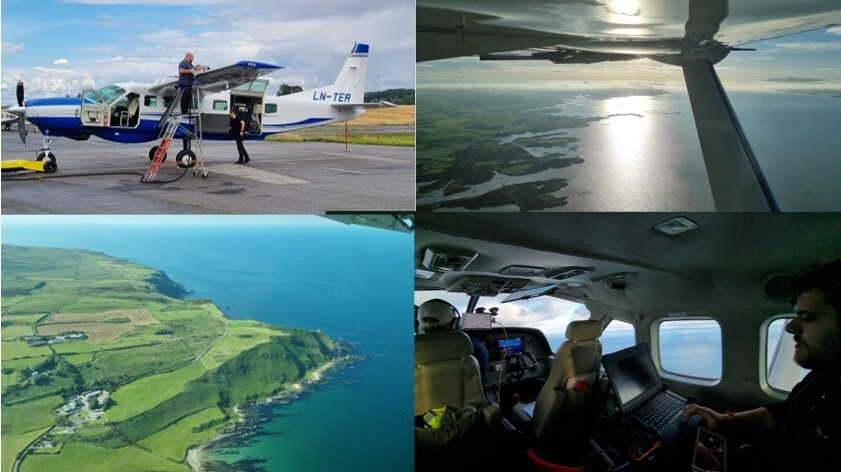
The image shows some pictures taken during one of the surveys: Field’s aircraft on the ground and in the air, with an image where both the pilot and the sensor operator are visible, as well as some aerial views of the Northern Ireland coastal zone. 


Insights and Analysis

The acquired lidar and imagery data were processed to generate cleaned and classified topo-bathymetric point clouds, digital elevation models, depth contours, as well as high-resolution orthophotos. Together, these products form a comprehensive and highly detailed dataset of the coastal zone of Northern Ireland.

In addition to bathymetry, the delivered products include gridded lidar return intensity and a separate classification of marine vegetation, both of which add significant value to the dataset. Lidar intensity supports the interpretation of seabed characteristics and spatial variability, while vegetation mapping provides insight into the distribution of submerged habitats such as kelp and seagrass.


Visualising the coastal zone

In the image slider below, we show excamples of how data turned into 3D visual imagery for deep insights of the coastal zone ecosystem.

Figure 1 shows Lough Foyle viewed from the northwest as a representative example of the survey results in the more turbid Loughs. Bathymetric lidar data are displayed with overlaid aerial imagery, and the red contour marks the target depth of ten metres. The dataset forms a continuous topo-bathymetric elevation model, capturing elevations above the water surface and bathymetric depths extending beyond ten metres in many areas.

Figure 2 shows an area around Cloughey on the eastern coast, illustrating a typical example of the bathymetric coverage achieved under more favourable conditions. Here, the combined lidar and imagery data reveal detailed underwater topography, with bathymetric penetration extending well beyond the ten-metre depth contour across most of the area.

Figure 3 presents Carlingford Lough, which exhibits similar challenges to Lough Foyle, including persistently high turbidity near the mouth of the River Newry. The yellow line indicates the coastline, the red contour marks the ten-metre target depth, and the white line represents the landward limit of existing multibeam sonar coverage. Sonar data are shown in grey, with bathymetric lidar data overlaid in colour.

The zone between the coastline and the sonar limit, the “white ribbon” area, is largely inaccessible to multibeam surveys due to shallow water depths and navigational constraints. Figure 5 clearly illustrates how airborne lidar bathymetry fills this gap, providing continuous coverage across the land–sea interface and demonstrating the strong complementarity between multibeam sonar and airborne bathymetric lidar for comprehensive coastal mapping.


Lough Foyle
 Figure 1. Lough Foyle 
Cloughey Bay beach

Figure 2: Cloughey Bay beach including imagery

Carlingford Lough

Figure 3: Carlingford Lough: bathymetric lidar data filling the gap


Survey Results

Following processing and quality control, approximately 85 percent of the Northern Ireland coastal zone was successfully mapped to depths of ten metres or greater using airborne lidar bathymetry. In clearer water areas, bottom detection frequently exceeded 25 metres, while in more turbid environments such as Strangford Lough, achievable depths were typically limited to around eight metres.

A small number of localised data gaps remain, primarily within major estuaries and sea loughs, as well as in isolated rocky or kelp-dominated nearshore sections. In these areas, persistently elevated turbidity, strong tidal sediment transport, dense marine vegetation, and/or dark, low-reflectance seabed materials limit laser penetration and reflection, even after repeated acquisition attempts under different environmental conditions.

Independent validation was carried out by the UK Hydrographic Office prior to final acceptance. Across all surveyed regions, the bathymetric data met the requirements of IHO S-44 Order 1b. The UKHO assessment confirmed good internal consistency and seamless integration across the land–sea interface and with adjacent multibeam sonar datasets.

Taken together, the results represent the most complete and consistent topo-bathymetric dataset acquired for the Northern Ireland coast to date. By effectively bridging the gap between terrestrial lidar coverage and deeper water multibeam surveys, the ALB dataset provides a robust foundation for coastal management, charting, engineering and environmental applications.

This project further demonstrates that airborne bathymetric lidar surveys can deliver reliable, data across extensive coastal zones, even under challenging environmental conditions. This successful project is likely to lower the barrier for future coastal lidar bathymetry initiatives in the United Kingdom and in other regions with similarly variable weather and water clarity.


Authors

Bernt Larsen

Bernt Larsen

Senior Project Manager - Airborne Mapping

Bernt holds an MSc in Geosciences. He previously served as Technical Manager for airborne sensor systems and since 2017, he has managed numerous lidar and imagery projects. He is Field’s subject matter expert in airborne lidar bathymetry and has been project manager for most of Field’s airborne bathymetric lidar projects.  

Charles

Charles de Jongh

Business Development Manager - Airborne Mapping

Charles holds an MSc in Cartography and Geographic Information Science and has more than two decades of experience in the marine geospatial sector.

Solutions géospatiales alimentées par des logiciels, des capteurs et des technologies d'IA.

Rejoignez-nous et aidez-nous à capturer et à transformer des données géospatiales précises en informations précieuses et en jumeaux numériques.